


-
 홈
홈
-
Publications
- JPI Archives
- Jeju Forum Journal
Jeju Forum Journal
전체 19건
-
- 저자
- Jeju Peace Institute
- 발간호
- Publication date: December 31, 2022
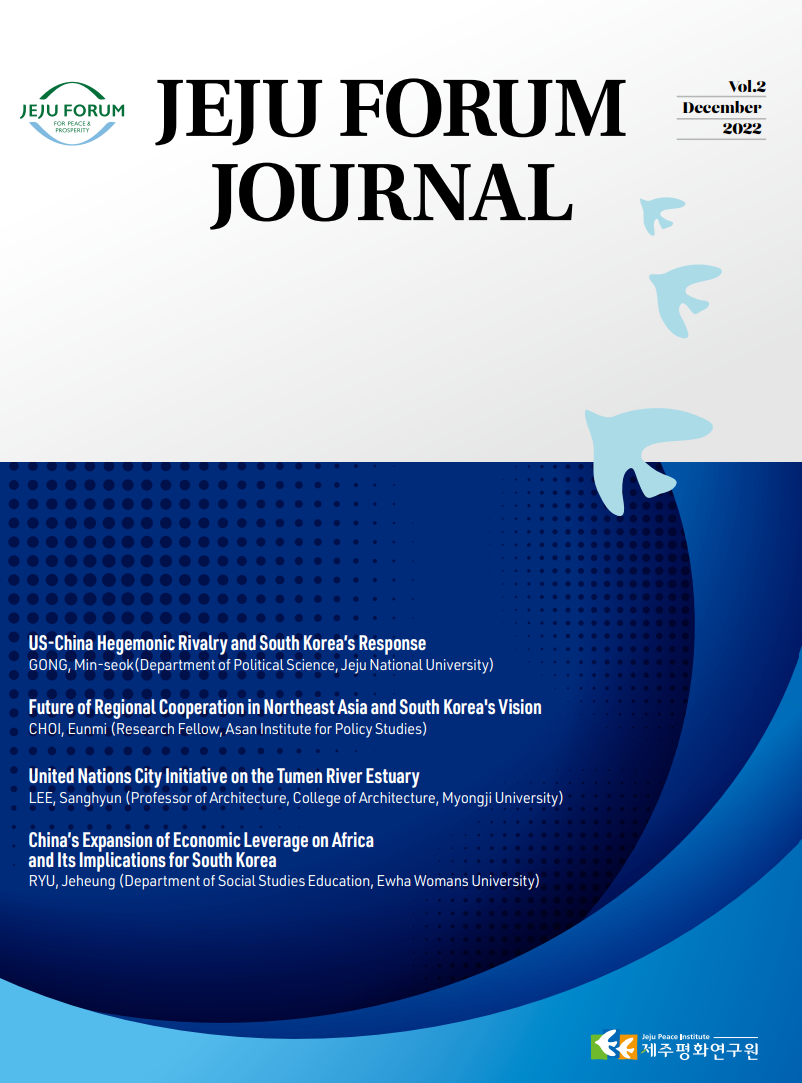
For this issue, four distinguished scholars have contributed their essays. The first essay, “US-China Hegemonic Rivalry and South Korea’s Response,” is written by Professor Gong Min-seok (Jeju National University). The second essay, “Future of Regional Cooperation in Northeast Asia and South Korea's Vision,” is contributed by Dr. Eunmi Choi (Asan Institute for Policy Studies). Each essay examines how South Korea should respond to the shift in international dynamics due to the intensifying US-China competition and why and how South Korea should continue to pursue multilateral cooperation in East Asia despite several obstacles. The other two essays also cover interesting topics that attract our attention. The third essay contributed by Professor Lee Sanghyun (Myongji University), “United Nations City Initiative on the Tumen River Estuary,” suggests the idea of building “United Nations City” as means to achieve peace on the Korean peninsula. The final essay, “China’s Expansion of Economic Leverage on Africa and Its Implications for South Korea,” written by Professor Jeheung Ryu (Ehwa Womans University), explains how China is increasing its economic influence in Africa, how the Sino-African relations are strengthening, and its implications to South Korea. Chapter 1. US-China Hegemonic Rivalry and South Korea's Response Chapter 2. Future of Regional Cooperation in Northeast Asia and South Korea's Vision Chapter 3. United Nations City Initiative on the Tumen River Estuary Chapter 4: China's Expansion of Economic Leverage on Africa and Its Implications for South Korea -
- 저자
- Jeju Peace Institute
- 발간호
- Publication date: December 31, 2022
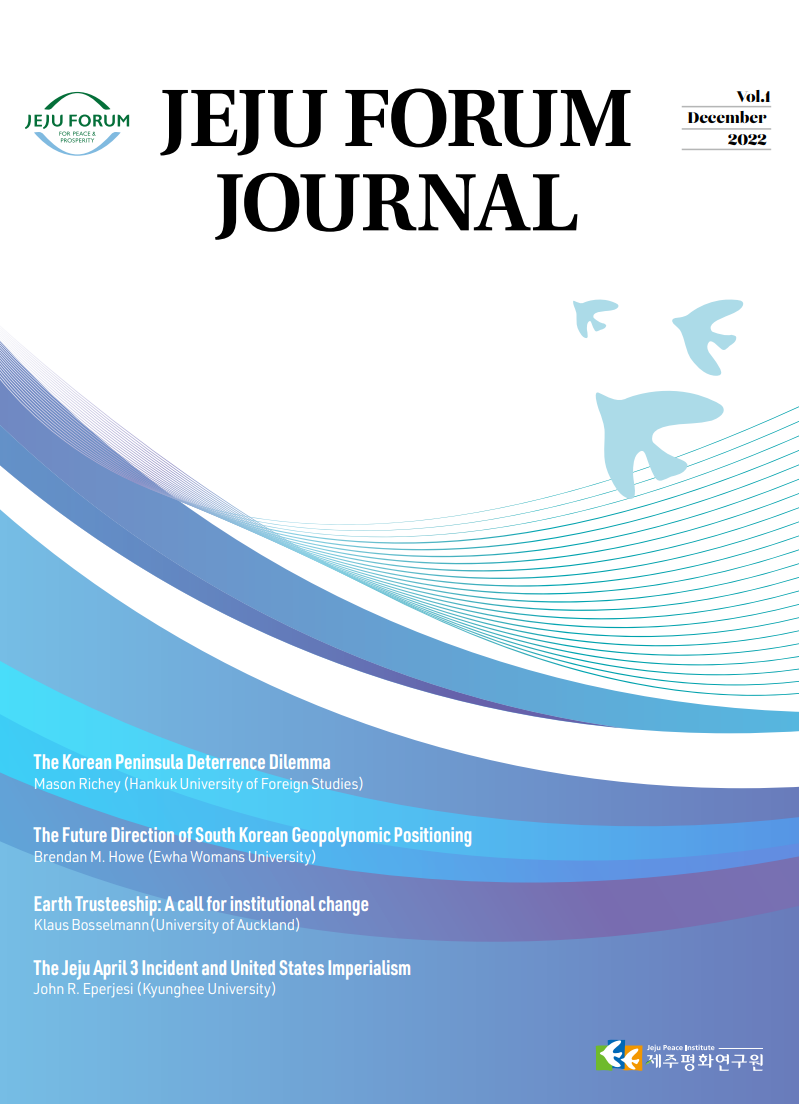
The two articles in this issue are contributed by the participants of the Jeju Forum. The first article, “The Korean Peninsula Deterrence Dilemma,” is written by Professor Mason Richey (Hankuk University of Foreign Studies). The second article, “The Future Direction of South Korean Geopolynomic Positioning,” is contributed by Professor Brendan Howe (Ehwa Womans University). The two articles examine the security situation surrounding the Korean peninsula and explore options South Korea could choose to deal with the challenges it faces and enhance its security. The two essays in this issue are also contributed by the participants of the 2022 Jeju Forum. The first essay contributed by Professor Klaus Bosselmann (University of Auckland), “Earth Trusteeship: A call for institutional change,” discusses why we need “Earth Trusteeship” governance to better address the global ecological crisis. The second essay, “The Jeju April 3 Incident and United States Imperialism,” written by Professor John R. Eperjesi (Kyunghee University), explains the role the US played in the Jeju April 3 incident and why the US should consider apologizing for its actions. These contributions cannot represent all the topics and issues discussed among the speakers at the Jeju Forum nor all the academic activities of the JPI. Still, through these four contributions, JPI hopes the readers will be able to get a glimpse of some of the essential topics and issues discussed at the Jeju Forum and throughout the year by the JPI. Chapter 1. The Korean Peninsula Deterrence Dilemma Chapter 2. The Future Direction of South Korean Geopolynomic Positioning Chapter 3. Earth Trusteeship: A call for institutional change Chapter 4: The Jeju April 3 Incident and United States Imperialism -
- 저자
- Jeju Peace Institute
- 발간호
- Publication date: December 31, 2021
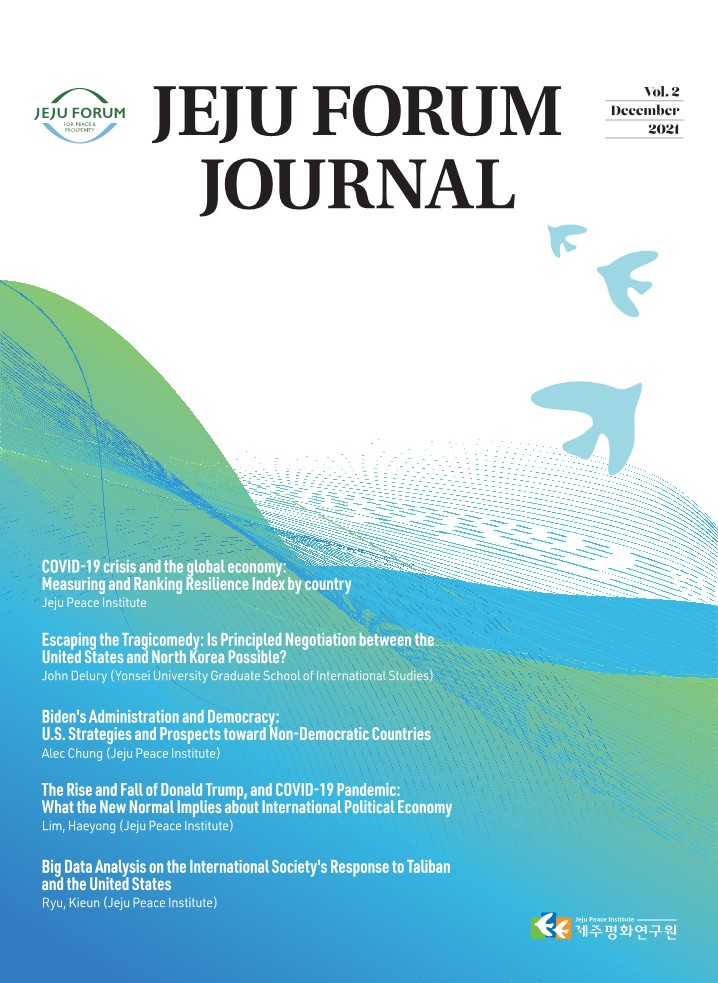
The two articles in this issue are contributed by the participants of the 2021 Jeju Forum. The first article, “COVID-19 crisis and the global economy: Measuring and Ranking Resilience Index by country,” is written and presented by the JPI researchers at the Jeju Forum – Dr. Alec Chung (Research Fellow), Dr. Haeyong Lim (Research Fellow), and Dr. Ki Eun Ryu (Postdoctoral Researcher). The JPI researchers created indices Economic Performance Index (EPI) and Economic Resilience Index (ERI). The second article is written by the participant of the session “ROK-U.S. Alliance under the Biden Administration: Way Forward” – Professor John Delury. He points out the importance of principled negotiation without any pre-set assumptions about the other. Finally, three JPI researchers have each contributed an essay for this volume of the Jeju Forum Journal. Dr. Alec Chung’s essay reviews the Biden Administration’s strategies toward non- democracies and suggests three possible scenarios on whether and how the US will cooperate with non-democracies. Dr. Haeyong Lim’s essay discusses how the new-normal driven by the US- China strategic competition and COVID-19 will transform the global political and economic order. Finally, Dr. Kieun Ryu’s essay examines how the international community viewed the Taliban and the US government after the Taliban’s occupation of Kabul, employing a big data analysis technique. These contributions cannot represent all the topics and issues discussed among the speakers at the 2021 Jeju Forum nor all the academic activities of the JPI. Still, through these five contributions, JPI hopes the readers will be able to get a glimpse of some of the essential topics and issues discussed at this year’s Jeju Forum and throughout the year by the JPI. Chapter 1. COVID-19 crisis and the global economy: Measuring and Ranking Resilience Index by country Chapter 2. Escaping the Tragicomedy: Is Principled Negotiation between the United States and North Korea Possible? Chapter 3. Biden's Administration and Democracy: U.S. Strategies and Prospects toward Non-Democratic Countries Chapter 4. The Rise and Fall of Donald Trump, and COVID-19 Pandemic: What the New Normal Implies about International Political Economy Chapter 5. Big Data Analysis on the International Society's Response to Taliban and the United States -
- 저자
- Jeju Peace Institute
- 발간호
- Publication date: December 31, 2021
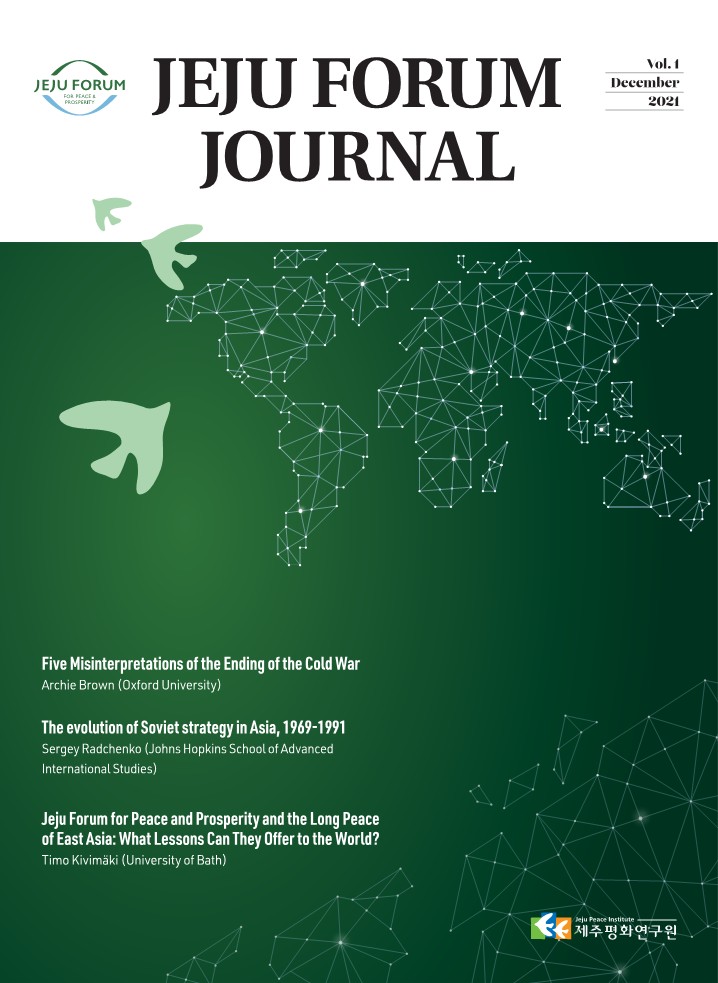
The Jeju Forum for Peace and Prosperity, which the Jeju Peace Institute (JPI) annually organizes, is an important opportunity for scholars, political leaders, diplomats, and activists from around the world to discuss current issues regarding peace, prosperity, and multilateralism; it gives our scholarly activities an important practical anchor as well as a point of reflection. This journal intends to be a bridge from one Forum to the next. Throughout the year, it wants to follow up on ideas brought forward within the Jeju Forum and establish new angles for the next. At the same time, it aims to provide an independent platform for our readers to better understand the environment and circumstances surrounding East Asia and the world. Specifically, the Jeju Forum Journal publishes manuscripts analyzing events that shaped the world we live in today; events that are expected to have severe repercussions on relations between states; foreign policies of certain states that can affect other states’ actions; and other issues that are widely discussed among the public, scholars, and global leaders today. The three articles in this issue are contributed by the participants of the 2021 Jeju Forum. The first article is written by Professor Archie Brown, who participated in the plenary session “The Peaceful Ending of the Cold War: Interpretations and Lessons.” The second and third articles are contributed by the participants of the plenary session “The Korea-Soviet Summit and Jeju, Island of World Peace.” Professor Sergey Radchenko too emphasizes Gorbachev’s importance for Sino-Soviet rapprochement – the critical turn in Soviet strategy – that affects Russia’s strategic relation to Asia till today. Finally, Professor Timo Kivimäki invites his audience to learn from East Asian negotiation tactics to help de-escalate conflicts. These three contributions cannot represent all the topics and issues discussed among the speakers at the 2021 Jeju Forum. Still, through these three contributions, JPI hopes the readers will be able to get a glimpse of some of the essential topics and issues shared by the participants who joined the Forum on/off-line.Chapter 1. Five Misinterpretations of the Ending of the Cold War Chapter 2. The evolution of Soviet strategy in Asia, 1969-1991 Chapter 3. Jeju Forum for Peace and Prosperity and the Long Peace of East Asia: What Lessons Can They Offer to the World? -
![[Jeju Forum Journal] The evolution of Soviet strategy in Asia, 1969-1991](/upload/board/thumb_journal_4c17aa68f3f872da69345cf66a9fbd14.jpg)
- 저자
- Sergey Radchenko (Johns Hopkins School of Advanced International Studies)
- 발간호
- 2021-04
This article reviews Soviet foreign policy towards Asia from 1969 to 1991. For much for the Cold War the focus of Moscow’s foreign policy agenda was actually in Europe. This was because the Soviet Union was primarily a European power, and the Soviet leaders regarded themselves as historically and culturally “European.” Moscow’s relationship with Asia was historically that of a European imperialist power, and the legacy of this experience was that the Soviets wanted to shape Asia, perhaps even to lead in Asia, but they certainly did not see themselves as a properly Asian player. They have always been on the outside looking in. Asia’s cultural “otherness” was compounded by Soviet security concerns. By the 1960s – as a result of the Sino-Soviet split – China emerged as the most significant threat to the USSR in the East. Dealing with this threat became the key preoccupation of Moscow’s Asian policy for much of the period under discussion. The article shows how Moscow coped with China in the 1970s – early 1980s, including by leveraging its relations with other regional players like India and Vietnam. This policy underwent change in the 1980s, primarily because of the Soviet Union’s international isolation and tensions in Soviet-American relations. The article then explores the continuities and change and Gorbachev’s approach to Asia, including his overtures to Japan and South Korea. The conclusion outlines how Moscow’s Asian policy changed since the collapse of the USSR, and in which ways it stayed in the same. Author Bio. Sergey Radchenko is the Wilson E. Schmidt Distinguished Professor at the Johns Hopkins School of Advanced International Studies. He has written extensively on the Cold War, nuclear history, and on Russian and Chinese foreign and security policies. He has served as a Global Fellow and a Public Policy Fellow at the Woodrow Wilson Centre and as the Zi Jiang Distinguished Professor at East China Normal University (Shanghai). Radchenko’s books include Two Suns in the Heavens: the Sino-Soviet Struggle for Supremacy (Wilson Center Press & Stanford UP, 2009) and Unwanted Visionaries: the Soviet Failure in Asia (Oxford UP, 2014). Radchenko is a native of Sakhalin Island, Russia, was educated in the US, Hong Kong, and the UK, where he received his PhD in 2005 (LSE). Before he joined SAIS, Radchenko worked and lived in Mongolia, China, and Wales. -
![[Jeju Forum Journal] Escaping the Tragicomedy: Is Principled Negotiation between the United States and North Korea Possible?](/upload/board/thumb_journal_736bdb1e858f9e278b0de3d90501a5fc.jpg)
- 저자
- John Delury (Yonsei University Graduate School of International Studies)
- 발간호
- 2021-03
This article asks whether “principled negotiation” as explained by William Ury and Roger Fischer in their classic book Getting to Yes is possible in the context of negotiations between the United States and North Korea. Answering this question leads to a description of two competing schools of interpretation among American analysts trying to explain why negotiations since the end of the Cold War have failed genres. In the end, however, it seems impossible to judge which of these schools—the comedic and the tragic—is correct. Instead, the article concludes by proposing two principles of interpretation—indeterminacy and entanglement—in place of the two. John Delury (jdelury@yonsei.ac.kr) is Professor of Chinese Studies at Yonsei University Graduate School of International Studies (GSIS), where he serves as chair of the undergraduate Program in International Studies at Yonsei’s Underwood International College (UIC), and founding director of the Yonsei Center on Oceania Studies. He is the author of a forthcoming history of US-China relations during the early Cold War (Agents of Subversion, Cornell University Press, 2022). His previous book, with Orville Schell, Wealth and Power: China's Long March to the Twenty-first Century, was published by Random House. In addition to his work on modern Chinese history and US-China relations, he also teaches and writes about Korean Peninsula affairs. His articles can be found in journals such as Asian Survey, Late Imperial China, and Journal of Asian Studies, his commentaries appear in Foreign Affairs, Foreign Policy, The New York Times, Washington Post, and 38 North, and he contributes book reviews for the quarterly journal Global Asia, where he is associate managing editor. Professor Delury is a member of the Council of Foreign Relations, National Committee on US-China Relations, and National Committee on North Korea; he is also Pacific Century Institute board member, Asia Society senior fellow, National Committee on American Foreign Policy leadership council member, and Center on Strategic and International Studies adjunct fellow. He is a member of the Republic of Ireland’s foreign affairs advisory network and is invited to offer his analysis on East Asian affairs with government, think tank, corporate, and civil society organizations globally. He received his BA, MA, and PhD in history from Yale University. -
![[Jeju Forum Journal] Jeju Forum for Peace and Prosperity and the Long Peace of East Asia: What Lessons Can They Offer to the World?](/upload/board/thumb_journal_38ad1bad43366d67e750f989278ee3b8.jpg)
- 저자
- Timo Kivimäki (University of Bath)
- 발간호
- 2021-02
This paper starts with the realisation that East Asia, since 1980, has been successful in preventing fatalities of organized violence compared to other regions, and compared to its performance three decades before 1980. The paper proceeds by establishing the recipes for the long peace of East Asia: non-interference, and developmental definition of state’s purposes. Once there is clarity of the East Asian recipe for peace, this paper moves to the contribution of the Jeju Forum for Peace and Prosperity and similar forums to the East Asian strategy for peace. There the conclusion is that Forums like the JFPP can offer support to several of the elements of the East Asian peace formula. Finally, the paper will investigate whether the East Asian and Jeju recipes for peace and prosperity could offer global prescriptions. Again, the conclusion is clear. The world could learn from East Asia and Jeju: some of the recipes that Jeju Forum for Peace and Prosperity supports, can be found useful also to the entire world.Timo Kivimäki is Professor of International Relations at the University of Bath, UK. Previously he has held professorships at the University of Helsinki, University of Lapland, and at the University of Copenhagen. Professor Kivimäki has also been director of the Nordic Institute of Asian Studies (Copenhagen) and the Institute of Development Studies of the University of Helsinki. In addition to purely academic work Professor Kivimäki has been a frequent consultant to the Finnish, Danish, Dutch, Russian, Malaysian, Indonesian and Swedish governments, as well as to several UN and EU organizations on conflict and terrorism. Kivimäki's recent articles on peace and conflict topics were published in the Chinese Journal of International Relations, Pacific Focus, the Pacific Review, Social Sciences, Journal of Refugee Studies, International Relations of the Asia Pacific, Journal of Peace Research, Journal of International Relations and Development, Asian Security and Middle East Policy. In his new books Protecting the Global Civilian from Violence: UN discourses and practices in fragile states (London, Routledge 2021) and Failure to Protect. The Path to and Consequences of Humanitarian Interventionism (Cheltenham: Edward Elgar Publishing, 2019) Professor Kivimäki revealed new patterns in contemporary warfare and made sense of them by looking at political discourses and cases of unilateral humanitarian intervention and UN peacekeeping. His conclusions on unilateral pattern of humanitarian intervention are damning: humanitarian interventions contribute to the increase in the number of fatalities among civilians and to the weakening of state capacity to contain violence. At the same time UN peacekeeping is much more successful. -
![[Jeju Forum Journal] Five Misinterpretations of the Ending of the Cold War](/upload/board/org_1777358942_.jpg)
- 저자
- Archie Brown (Oxford University)
- 발간호
- 2021-01
There are some generalizations about the end of the Cold War which are widely believed but are greatly misleading. The following five are among the most popular misinterpretations of the Cold War’s ending: (1) The Cold War ended with the breakup of the Soviet Union in December 1991; (2) The Reagan Administration’s military buildup forced the Soviet Union to concede defeat in the Cold War; (3) The Soviet Union’s inability to compete with the West economically left it with no option but to reform; (4) A Western ideological offensive against Communism, led by Ronald Reagan with important help from Margaret Thatcher, forced the Soviet Union to change its thinking; (5) If Mikhail Gorbachev had not been chosen as Soviet leader in March 1985, some other Soviet leader would have had to pursue similar policies and the Cold War would still have ended largely on Western terms.Archie Brown is Emeritus Professor of Politics at the University of Oxford, a Fellow of the British Academy and an International Honorary Member of the American Academy of Arts and Sciences. His most recent book is The Human Factor: Gorbachev, Reagan, and Thatcher, and the End of the Cold War (2020). His other books include The Myth of the Strong Leader: Political Leadership in the Modern Age (2014; Korean edition, 2017), chosen by Bill Gates as a book of the year; The Rise and Fall of Communism (2009); and The Gorbachev Factor (1996). -
- 저자
- Min, Jeonghun (Korea National Diplomatic Academy)
- 발간호
- 2
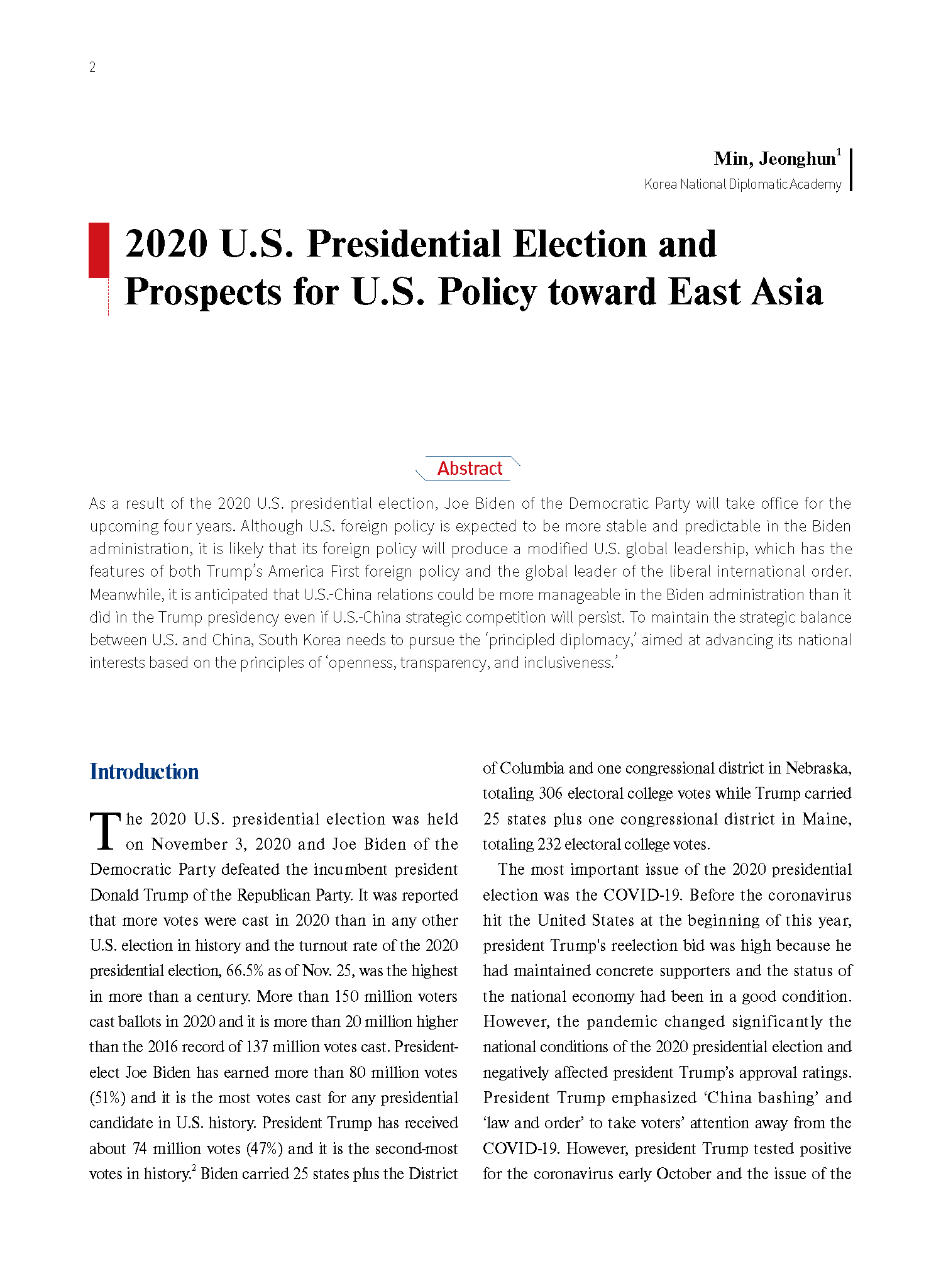
As a result of the 2020 U.S. presidential election, Joe Biden of the Democratic Party will take office for the upcoming four years. Although U.S. foreign policy is expected to be more stable and predictable in the Biden administration, it is likely that its foreign policy will produce a modified U.S. global leadership, which has the features of both Trump’s America First foreign policy and the global leader of the liberal international order. Meanwhile, it is anticipated that U.S.-China relations could be more manageable in the Biden administration than it did in the Trump presidency even if U.S.-China strategic competition will persist. To maintain the strategic balance between U.S. and China, South Korea needs to pursue the ‘principled diplomacy,’ aimed at advancing its national interests based on the principles of ‘openness, transparency, and inclusiveness.’Dr. Min, Jeonghun is an associate professor in the department of American Studies at the Korea National Diplomatic Academy (KNDA). Before joining the KNDA, he taught Political Science courses as an assistant professor of political science at Northeastern State University in Oklahoma, US. He is interested in conducting research on American Politics, ROK-U.S. relations, and North Korea-U.S. relations. He has published his research in academic journals, including International Political Science Review, Social Science Journal, Asian Survey, Journal of International Studies, Journal of American Studies, Korean Journal of International Studies, Korean Journal of Area Studies, Journal of Korean Political and Diplomatic History, Journal of Research Methodology, and Midsouth Political Science Review. Dr. Min, received his Ph.D. in political science from the University of Georgia. -
- 저자
- Robert Sutter (George Washington University, USA)
- 발간호
- 2
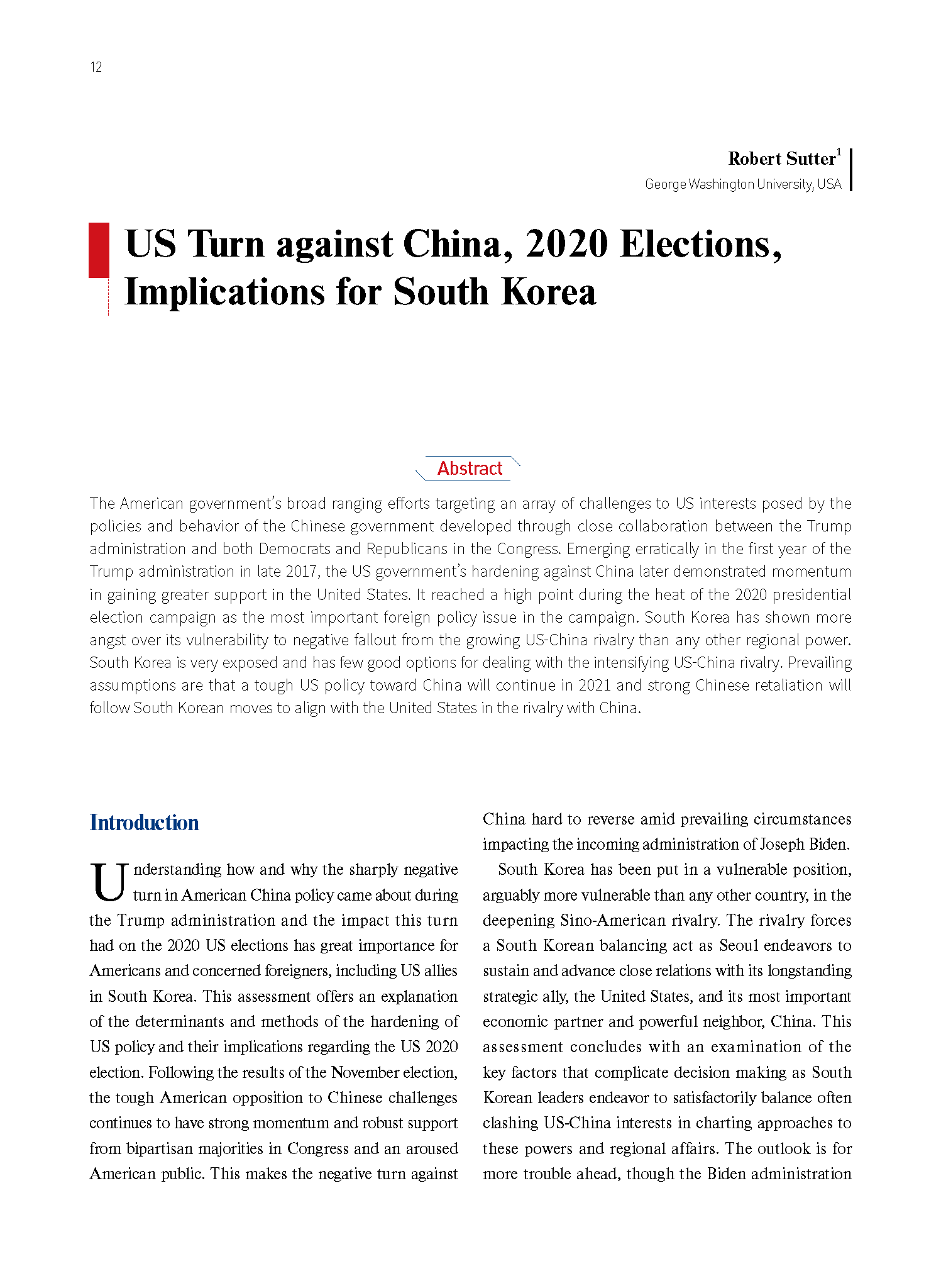
The American government’s broad ranging efforts targeting an array of challenges to US interests posed by the policies and behavior of the Chinese government developed through close collaboration between the Trump administration and both Democrats and Republicans in the Congress. Emerging erratically in the first year of the Trump administration in late 2017, the US government’s hardening against China later demonstrated momentum in gaining greater support in the United States. It reached a high point during the heat of the 2020 presidential election campaign as the most important foreign policy issue in the campaign. South Korea has shown more angst over its vulnerability to negative fallout from the growing US-China rivalry than any other regional power. South Korea is very exposed and has few good options for dealing with the intensifying US-China rivalry. Prevailing assumptions are that a tough US policy toward China will continue in 2021 and strong Chinese retaliation will follow South Korean moves to align with the United States in the rivalry with China.Robert Sutter is Professor of Practice of International Affairs at the Elliott School of George Washington University (2011- ). He also served as Director of the School’s main undergraduate program involving over 2,000 students from 2013-2019. His earlier fulltime position was Visiting Professor of Asian Studies at Georgetown University (2001-2011). A Ph.D. graduate in History and East Asian Languages from Harvard University, Sutter has published 22 books (four with multiple editions), over 300 articles and several hundred government reports dealing with contemporary East Asian and Pacific countries and their relations with the United States. His most recent book is Chinese Foreign Relations: Power and Policy of an Emerging Global Force Fifth Edition (Rowman & Littlefield, 2021). Sutter’s government career (1968-2001) saw service as senior specialist and director of the Foreign Affairs and National Defense Division of the Congressional Research Service, the National Intelligence Officer for East Asia and the Pacific at the US Government’s National Intelligence Council, the China division director at the Department of State’s Bureau of Intelligence and Research and professional staff member of the Senate Foreign Relations Committee.


