-
 홈
홈
-
Publications
- JPI PeaceNet
JPI PeaceNet
| [JPI PeaceNet]Did COVID-19 Increase National Pride in South Korea? |
|
|
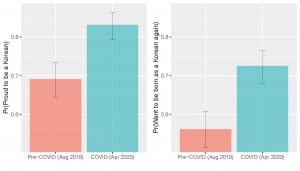
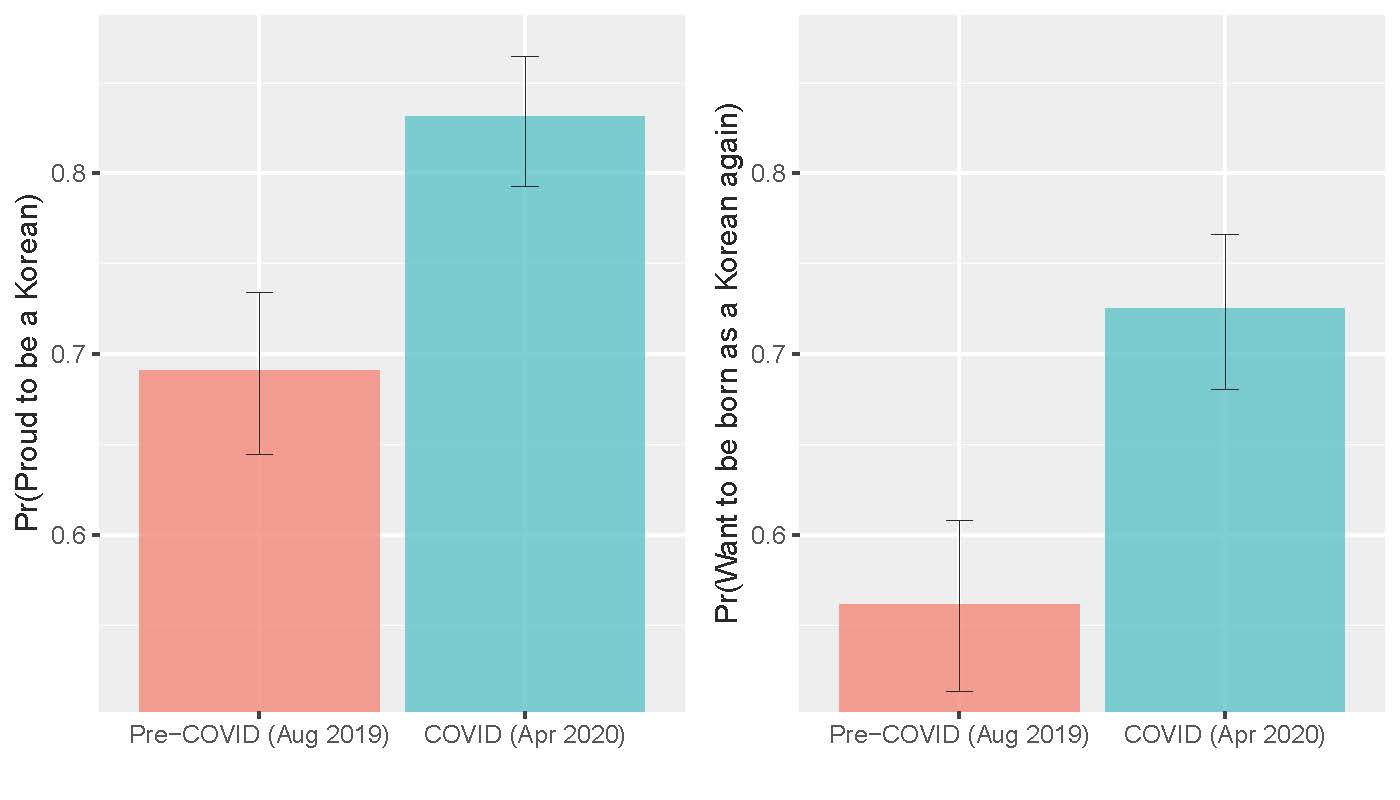
전세계가 팬데믹과 분투한 지 2년이 가까워 오는 지금, 각 국은 단계적 일상회복과 포스트 코로나 시대를 준비하고 있다. 그동안 각 국이 이 세계적 규모의 보건위기를 해결하는 방법의 효과성에는 큰 차이가 존재했으며, 전 세계 시민들은 공식적, 비공식적 미디어를 통해 자국의 성과를 다른 국가의 성과와 쉽게 대조할 수 있었다. 이 과정에서, 팬데믹의 심각성과 이에 대한 정부의 대응은 팬데믹 기간 국가 자부심을 결정하는 중요한 요소가 되었다. JPI PeaceNet은 고려대학교 임시정 교수의 기고문에서 서베이를 통해 드러난 코로나 전, 후 한국 국민들의 국가자부심 변화를 살펴보고 그 함의를 찾아보고자 한다. [기획: 유기은 박사후연구원 (keryu@jpi.or.kr)] Exogenous shocks and National Pride Exogenous shocks such as national disasters and pandemics have a profound influence on how citizens think about the virtues and failings of their country and society. Governance failures in response to such shocks cause social disruptions and undermine the government's credibility (Omelicheva, 2011; Deverell, 2020; Mukherjee, 2015; Malhotra & Kuo, 2008). But does the successful handing of exogenous shocks enhance trust in government and society, and more broadly, encourage citizens to take pride in their country? The discussion on the nexus between the handling of exogenous shocks and national pride is particularly relevant in the context of the COVID-19 pandemic. There was significant variation in the effectiveness of how countries tackled this global-scale health crisis. And, more than ever before, citizens across the world had easy access to cross-country information on infections and mortality, often amplified on social and traditional media, which compared and contrasted their country’s performance with that of others. Google, for instance, provides daily COVID case charts for 191 countries based on Johns Hopkins University Center for Systems Science and Engineering (JHU CSSE). Other sources include CNN’s World COVID tracker and Bloomberg’s COVID Resilience Ranking. We explore how the national response to COVID-19 affected national pride in South Korea (Korea hereafter), which was widely celebrated for its pandemic response during the first half of 2020. At the time, the Director-General of the World Health Organization, Tedros Adhanom Ghebreyesus, urged countries to “apply the lessons learned in Korea and elsewhere” (Fisher and Choe, 2020). Some international leaders sought to proclaim their association with Korea. Maryland’s Governor Larry Hogan bragged that because he is known as Korea’s “son-in-law” (he is married to a Korean), he was able to quickly secure COVID-19 help from Korea (Hogan 2020). Research Design To empirically assess the relationship between the COVID-19 response and national pride, we draw on a unique dataset of surveys conducted by Korea Research in August 2019 (pre-COVID-19) and April 2020 (during COVID-19). The dates when the April survey was fielded, April 10-13, correspond with the end of the first wave of infections. In those four days, Korea reported less than 30 new cases daily. Both surveys asked two general questions about national pride: “I am proud of being a Korean” and “I want to be reborn as a Korean (in my next life).” Our empirical strategy is to compare the level of national pride between two time points using cross-sectional surveys conducted before (August 2019) and during (April 2020) the COVID-19 crisis. We expect both measures of national pride to be higher in April 2020 than in August 2019. To gain additional confidence that the pride increase is attributable to COVID-19, we also examine changes in pride in specific domains: 1) civic awareness of citizens (Citizenship), 2) international leadership (International), 3) popular culture (Pop Culture), 4) economic competitiveness (Economy), and 5) politics and democracy (Politics). These measures help us account for the confounding effects of other events such as the escalation of the trade war with Japan ongoing since July 2019 and the historic Oscar win of the Korean film Parasite in February 2020 (Choe 2020). The domain specific pride measures also allow us to conduct the test of two mechanisms liking the pandemic to national pride: social-psychological “rally-round-the-flag” effect vs. rational and nuanced interpretation of their country’s successful handling of the crisis. The former mechanism expects an increase in pride across all five domains. The latter mechanism predicts an increase in pride only in domains that are directly relevant to COVID-19 experience. The most significant increase is expected in the domain of civic awareness of citizens. Citizens’ compliance with self-quarantine mandates and the voluntary use of facemasks in public spaces were key to successfully managing the COVID-19 crisis. International leadership is another domain that Koreans are expected to take pride in. The Korea Disease Control and Prevention Agency (KDCA) shared its quarantine strategies with foreign countries, and Korean companies donated test kits and masks to foreign countries struggling with the virus, all of which received positive media attention. Findings We conduct a weighted regression analysis on the matched dataset and visualized our main findings, the substantive effect of COVID-19 on national pride, in Figure 1.[1] We find a significant increase in the general measures of national pride between 2019 and 2020. The probability that one feels proud of being Korean increased from under 70% in August 2019 to over 80% in April 2020. Similarly, the probability that one wants to be reborn as a Korean increased from around 56% in 2019 to over 70% in 2020. Figure 1
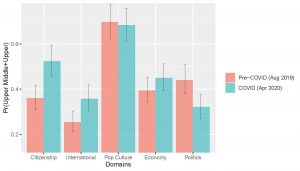
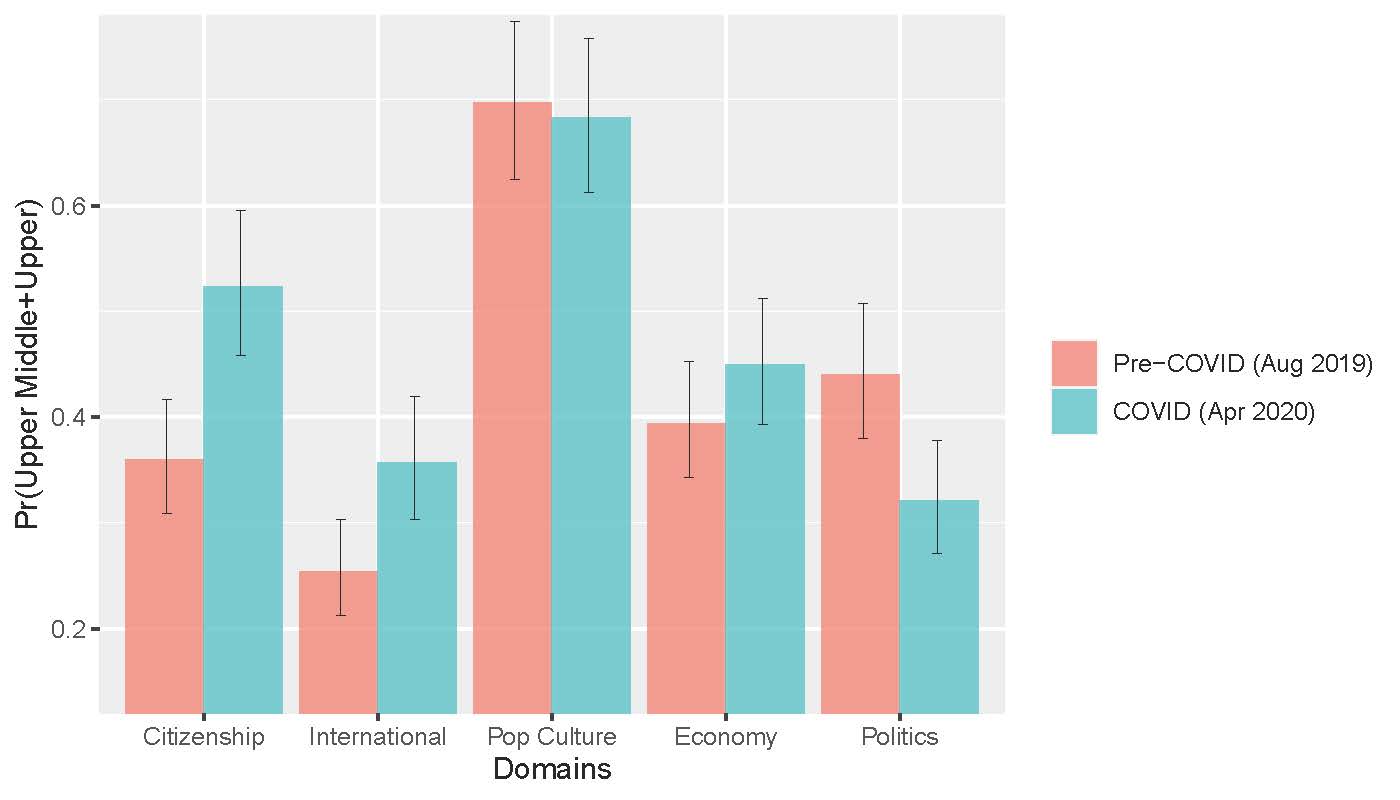
We move on to exploring domain-specific pride measures. We plot the predicted probabilities of placing Korea at the “upper-middle” or “upper” positions in pre-COVID-19 (red bars) and during COVID-19 (blue bars), respectively. The most dramatic improvement is observed in the domain of Citizenship, followed by International leadership, the two pride domains directly related to COVID-19. We observe a 15%-point improvement (from 37% to 52%) in the Citizenship domain and over a 10%-point improvement in the International leadership domain. As for the domains of Economy and Pop Culture, we do not observe any significant change in citizen perception. Interestingly, respondents’ assessment of Korea’s position in the domain of Politics worsened in April 2020 compared to August 2019. Our findings suggest that while respondents attribute the successful pandemic management to the Korean nation, especially in the high civic awareness of fellow citizens, they show growing dissatisfaction towards the political class over the affairs of the Korean state. These findings together provide some evidence that the increase in national pride could be attributed to COVID-19 rather than other confounding factors. These domain-specific analyses also suggest that taking pride in the successful COVID-19 response was not merely the result of a “rally-round-the-flag” effect. Koreans recognize the uniqueness of the COVID-19 challenge and offer a remarkably rational and nuanced interpretation of their country’s successful handling of the crisis. They view it as a victory for the Korean nation as opposed to the Korean state. Figure 2
Discussion Our research note has important implications for the study of national identity in times of crisis, COVID-19 in our case. We show that the successful handling of a global health crisis is associated with an increase in citizens’ national pride. By looking separately at domain specific period, we also show that the increase in pride is observed only in the domains more directly related to the successful handling of COVID-19. Is the increase in national pride a “good thing”? After all, populists across the world are harping on national pride. Would COVID-19 then provide additional fodder to the populists? Scholars consider nationalism and patriotism to be two distinct sources of national pride (Skitka 2006; Blank and Schmidt 2003). Nationalism-driven pride is based on the sense of national superiority and, by extension, exclusionary and dominating attitudes towards “others.” It is plausible that mask wearing, social distancing, and quarantine measures that have disrupted the normal lives of many during the pandemic could reinforce such inward-looking nationalist sentiment and the scapegoating of other countries. Patriotism-driven pride, on the other hand, does not rely on such exclusionary attitudes. Rather, it centers on the admiration of internal values, norms, and achievements and the tendency to maintain them (McDaniel et al. 2016). In turn, such constructive patriotic commitments are suggested to have the potential to motivate citizens to perform civic duties (Richey 2011) and provide support for more inclusive public policies (Brubaker 2004; Laborde 2002; Konrad and Qari 2012; Gangl et al. 2016). The pandemic, as a common threat, can renew a sense of community and provide an opportunity for governments and citizens alike to demonstrate their ability to act collectively, overcoming class, religious, ethnic and linguistic divides. These actions could range from new social norms on masks wearing to providing meals to vulnerable sections of society who have lost jobs. Did the Korean COVID-19 response enhance patriotic pride as opposed to nationalist pride? We find that COVID-19 enhanced Korean’s pride in their civic awareness; after all, citizens voluntarily followed government guidelines of social distancing and mask wearing. Such civic engagement reinforced in the time of a national crisis could enhance the norms of reciprocity and mutual trust and thus could increase social capital and foster patriotism (Galston 2007). One might also argue that Korean pride is inclusive patriotic pride because respondents are proud of their country’s role in international cooperation to manage COVID-19. It might reflect a nascent surge in “globally sensitive patriotism” that can drive public support for policies serving global justice such as foreign aid projects (Nussbaum 2008). Of course, social capital could also have a darker side. Berman’s (1997) classic work showed how a robust German civil society in the 1920s facilitated the rise of the Nazi party and led to the demise of Weimar Germany. Similarly, Chambers and Kopstein (2001) note the resurgence of “dark” civil society. One could argue that the xenophobic reaction in Korea to immigrant workers and refugees suggests that social cohesiveness could play out in an inclusive as well as exclusive manner. Thus, it is critical to recognize that in Korea, social cohesiveness could be associated with nationalist as well as patriotic pride. Unfortunately, our survey data do not contain a measure or proxy that allows us to separate nationalistic and patriotic attitudes. Future research can empirically explore this by employing distinct measures for nationalism and patriotism. [1] Please read the full paper (https://doi.org/10.1111/nana.12749) for details on the estimation strategy. We performed exact matching based on the following binary/categorical covariates: Gender, Age, Progressive/Conservative/Moderate, College Education, Income, and Region. All models control for these covariates. References Berman, S. (1997). Civil society and the collapse of the Weimar Republic. World Politics, 49, 401–429. Blank, T., & Schmidt, P. (2003). National identity in a united Germany: Nationalism or patriotism? An empirical test with representative data. Political Psychology, 24(2), 289–312. Chambers, S., & Kopstein, J. (2001). Bad civil society. Political Theory, 29(6), 837–865 Choe, S. (2020). “Oscar for ‘Parasite’ quenches Koreans' long thirst for recognition,” The New York Times, 10 February. Deverell, W. (2020). “Warren Harding tried to return America to ‘normalcy’ after WWI and the 1918 pandemic. It failed.” Smithsonian Magazine 19 May. Fisher, M., & Choe, S. (2020). “How South Korea flattened the curve,” The New York Times, 10 April. Galston, W. A. (2007). Civic knowledge, civic education, and civic engagement: A summary of recent research. International Journal of Public Administration, 30(6–7), 623–642. Gangl, K., Torgler, B., & Kirchler, E. (2016). Patriotism's impact on cooperation with the state: An experimental study on tax compliance. Political Psychology, 37(6), 867–881. Hogan, L. (2020). Fighting alone: I'm a GOP governor. Why didn't Trump help my state with coronavirus testing? The Washington Post, 16 July. Konrad, K. A., & Qari, S. (2012). The last refuge of a scoundrel? Patriotism and tax compliance. Economica 79(315), 516–533. Laborde, C. (2002). From constitutional to civic patriotism. British Journal of Political Science, 32, 591–612. Malhotra, N., & Kuo, A. (2008). Attributing blame: The public's response to hurricane Katrina. The Journal of Politics, 70(1), 120–135. Mukherjee, J. (2015). Hungry Bengal: War, famine and the end of empire. Oxford University Press. Nussbaum, M. C. (2008). Toward a globally sensitive patriotism. Daedalus, 137(3), 78–93. Omelicheva, M. (2011). Natural disasters: Triggers of political instability? International Interactions, 37(4), 441–465. Richey, S. (2011). Civic engagement and patriotism. Social Science Quarterly, 92(4), 1044–1056.Skitka, L. (2006). Patriotism or nationalism? Understanding post-September 11, 2001, flag-display behavior 1. Journal of Applied Social Psychology, 35(10), 1995–2011. 기획: 유기은 박사후연구원 편집: 김애리 연구원 Sijeong Lim is Associate Professor in the Division of International Studies at Korea University. She has previously held appointments at University of Amsterdam and Stockholm University. Her research focuses on international determinants of domestic politics, especially in the domains of welfare state politics and environmental politics. She has published in major social science journals including Governance, Socio-economic Review, World Development, and Public Administration Review. Aseem Prakash is Professor of Political Science and the Walker Family Professor for the College of Arts and Sciences at University of Washington. He is a member of National Academies of Sciences Board on Environmental Change and Society and International Research Fellow at the Center for Corporate Reputation, University of Oxford. His recent awards include the American Political Science Association's 2020 Elinor Ostrom Career Achievement Award in recognition of "lifetime contribution to the study of science, technology, and environmental politics," and the International Studies Association's 2019 Distinguished International Political Economy Scholar Award that recognizes "outstanding senior scholars whose influence and path-breaking intellectual work will continue to impact the field for years to come." |
|